Straight answers to what buyers ask us most about kitchen sinks.
Quartz or stainless steel — which kitchen sink should I choose?
+
Both are sound choices; they fail in different directions rather than one being better. Choose quartz composite if noise bothers you, if the sink is visible from a living or dining area, or if you want a colour other than steel — it does not dent, does not show water spotting, and the pigment runs through the body. Choose stainless steel if the budget is tight, if the kitchen is rented or temporary, or if you want something you can swap out in an afternoon without disturbing the countertop. Steel is lighter and cannot chip; quartz is quieter and warmer to look at.
What is a quartz kitchen sink made of?
+
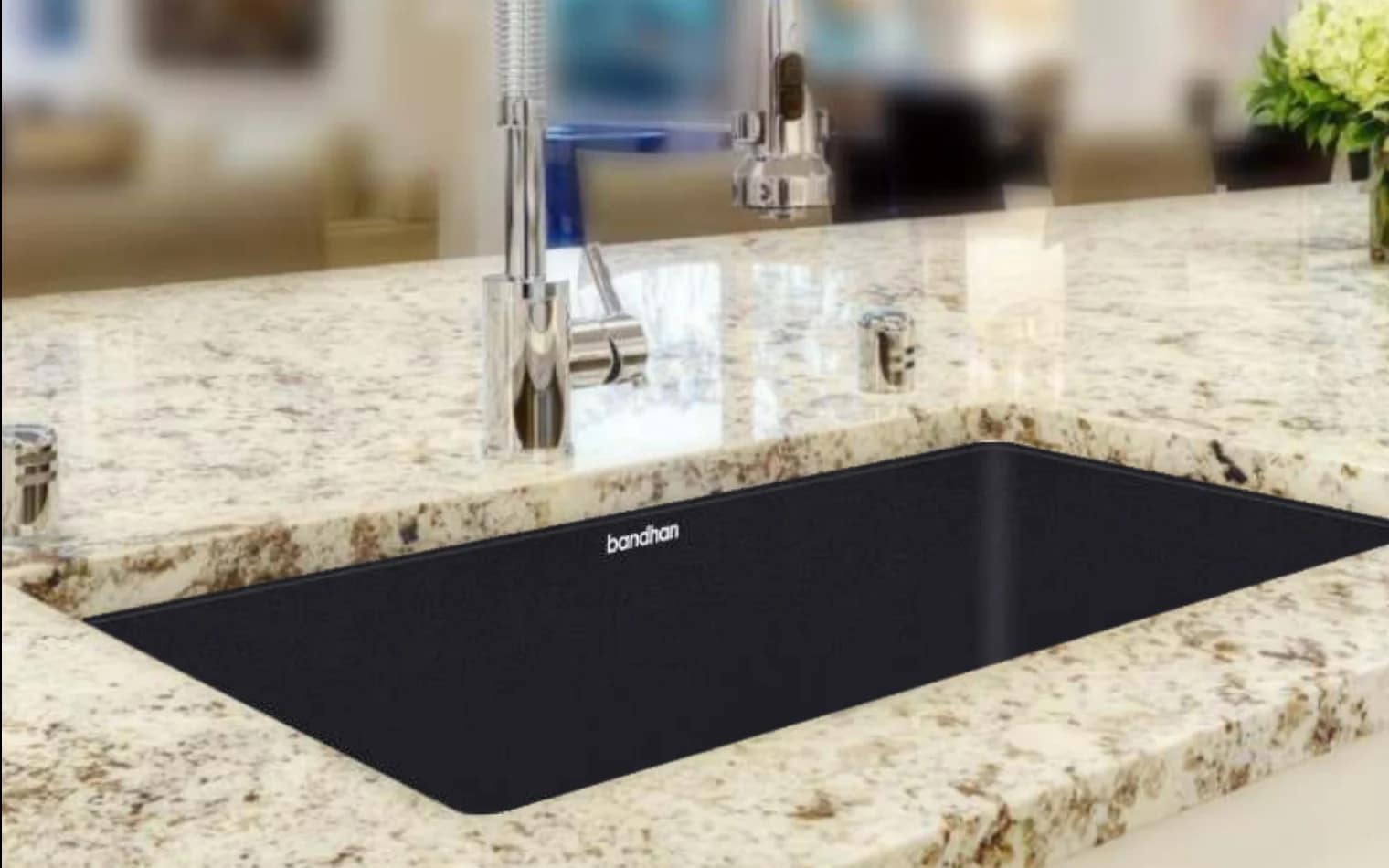
A quartz — or granite composite — sink is moulded from crushed natural quartz, typically around 80% by weight, bound in an acrylic or polyester resin. That makes it a solid, non-porous mass rather than a coated surface. Because the pigment is mixed through the whole body, a scratch or a chip does not reveal a different colour underneath the way it does on an enamelled or coated sink.
What is the difference between SS 304 and SS 202 sinks?
+
SS 304 is the food-grade 18/8 stainless — roughly 18% chromium and 8% nickel — and that nickel content is what gives it real corrosion resistance. SS 202 replaces most of the nickel with manganese, which makes it cheaper but far more prone to pitting and rust staining, usually appearing first around the drain and along the tap ledge in hard water. Ask which grade you are being quoted and get it stated on the invoice; the price difference is small next to the cost of replacing a rusted sink.
What gauge stainless steel sink is best?
+
Gauge is thickness, and the number runs backwards — lower is thicker. 16 gauge (around 1.5 mm) is the premium specification: rigid, quiet and heavy in the hand. 18 gauge (around 1.2 mm) is the sensible standard for a domestic kitchen. At 20 or 22 gauge the bowl flexes when you lean on it and drums loudly when a vessel goes in, and no amount of dampening pads fully fixes that. Press down on the centre of the bowl in the showroom — if it gives, go thicker.
Can I put hot utensils directly into a kitchen sink?
+
Yes, with both materials. Stainless steel is entirely unaffected by anything that comes off a domestic burner. Quartz composite sinks are rated for direct contact with hot cookware, typically to around 280°C, so a pan straight off the flame will not mark or warp the bowl. The one thing to avoid on quartz is severe thermal shock in reverse — do not pour ice water into a bowl that has just had boiling oil in it.
Do quartz sinks stain or scratch?
+
They resist both far better than steel or enamel, but they are not magic. In hard water — which is most of Telangana and coastal Andhra — light-coloured sinks can develop a limescale film if left wet. Wipe the bowl dry after use and clean weekly with a mild cream cleaner; for scale, a diluted vinegar soak lifts it. Avoid strong acids, drain-opening chemicals and steel scrubbers.
What is a handmade stainless steel sink?
+
A handmade sink is fabricated from thick sheet and welded at the corners, which allows a tight internal radius — usually quoted as R10 — and near-vertical walls. The result is squarer, holds more, and is normally made in 16 gauge. A pressed or drawn sink is stamped from a single sheet, so it has softly rounded corners and is typically thinner. Handmade costs more and suits under-mount installation on a solid-surface counter; pressed is perfectly adequate for a top-mount fit.
What size kitchen sink should I buy?
+
Work from the base cabinet, not the counter. Allow about 50 mm of clearance on each side of the sink within the internal cabinet width — so a 24-inch base unit takes a sink of roughly 21 inches. Common Indian sizes run from 18×16 inches for a compact single bowl up to 37×18 inches and beyond for a bowl-and-drainboard. Bowl depth of 8 to 10 inches suits Indian utensils.
Single bowl or double bowl for an Indian kitchen?
+
A single large bowl usually wins. Indian cooking generates big vessels — pressure cookers, kadais, idli stands — and a half bowl in a double-bowl sink is often too small to take them flat. Choose a double bowl only if you genuinely wash in two stages, or a bowl-and-drainboard layout if you have the counter length, which gives you draining space without shrinking the wash bowl.
Should I choose an under-mount or top-mount sink?
+
Top-mount (drop-in) is simpler, cheaper to fit and works on any countertop material — the rim sits on the counter and covers the cut edge. Under-mount fixes below the counter for a seamless line you can sweep crumbs into, but it requires a solid-surface counter such as granite or engineered quartz with a properly polished cut-out. Decide before the countertop is fabricated, because the cut differs.